Showing posts with label tree diagram. Show all posts

Wednesday, September 5, 2012

Rock, Paper, Scissors

1 2 3 Shoot......I win!
So, today in class we played rock, paper, scissors! Math was involved, so don't worry and it was still fun. We worked in pairs and played 45 games of rock, paper, scissors. I was paired with Amber, enough said. Now, after each game we would record the outcomes and put tally marks in a matrix, like this one:

As you can see I'm pretty good at this game....not really. After calculating the experimental probability of me winning, which was 12 out of 45 ( we calculated that by looking at how many times I won over the total number of games we played) and the probability of Amber winning, which was 16 out of 45 (same process), Amber and I were pretty even throughout the games. Yet we both apparently liked paper! Based on our outcomes, you could say that the game rock, paper, scissors is fair but under the ideal circumstances the theoretical probabilities would all have to be 1 out of 3.  But ours was pretty close to fair.

Under the same idea circumstances you could take this game and analyze it using a tree diagram. The probability of playing/showing a rock, paper or scissor would all be one third. Now lets say you showed a rock for the first game, for the second game you have the same probability of playing/showing a rock, paper or scissor as the first game, one third. If the game rock, paper, scissors was repeated a large number of times, our experimental probabilities would approach a fixed number. This is called Bernoulli's Theorem or Law of Large Numbers.

I never knew the simple game of rock, paper, scissors could help you learn probability in your college level math class, but it can! Also, did you know that there are professional competitions for rock, paper, scissors? Check it out! Until next time, which will probably be tomorrow! :)

Lauren 


Wednesday, August 29, 2012

Khdshweiazlkanncbvqojj

 Probability Day #2!

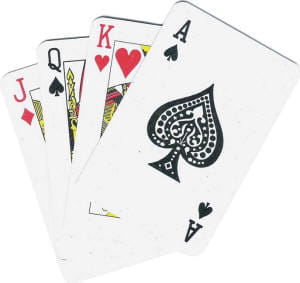
Today was our second day learning probability and let me tell you that at some points my brain was spinning, hence the title of my blog. We started out with a card activity, pretty tame. We were asked questions like what is the probability of drawing a red card from the deck. We solved this question by first determining how many cards are in a deck: 52. We then asked ourselves how many suits are in a deck: 4 (diamonds, hearts, clubs, and spades) and how many of those suits are red: 2 (diamonds and hearts). So, 26 out of 52 cards are red, or one half. We had other questions like what is the probability of drawing not a queen from the deck. First we had to figure out how many queens are in a deck of cards: 4 (one diamond, one heart, one club, and one spade). Since the question asked what is the probability of not drawing a queen, we subtracted the four queens from the total number of cards which was 52. So, 48 out of 52 or 12 out of 13 (after reduced) were not queens.

The next activity we did in class involved cute little black and white pom poms. Don't let the cute part throw you off, they were vicious! Anyway, with this activity we were given questions that told us we had a box that contained three white pom poms and two black pom poms. A pom pom would be drawn from the box at random and not replaced. Then a second pom pom was to be drawn from the box and not replaced. We needed to draw a tree diagram and find all possible outcomes.  So, with the first draw we could get a white pom pom or a black pom pom. The probability of pulling a white pom pom was 3 out of 5 and the probability of pulling a black pom pom was 2 out of 5 (5 being the total number of pom poms in the box). Next, we had to make a second draw. Now remember we already pulled a pom pom from the box and didn't replace it, so the total number of pom poms will change. So, lets say we pulled a white pom pom from the box on our first draw. When we draw for the second time, we still have the possibility of pulling a white or black pom pom again. The probability of pulling a white pom pom would be 2 out of 4 because there is a total of four pom poms in the box after you drew the first one and didn't replace it. And since we said the first pom pom we drew was white, then there are only two white pom poms left in the box. The probability of pulling a black pom pom would also be 2 out of 4 because there are a total of four pom poms and since we didn't pull a black pom pom on our first draw, the two original black pom poms are still in the box. The same process applies if you were to draw a black pom pom on your first draw instead of a white pom pom. The numbers would be slightly different.       

Click here for an example of a tree diagram of flipping a coin.

So to say the least, it was a big day in math class. Some things I was able to grasp pretty easily, while other things I struggled with and will need more practice on. But hey, that's where math homework comes in handy. I hope your head isn't spinning too bad......until next time! :)

Lauren